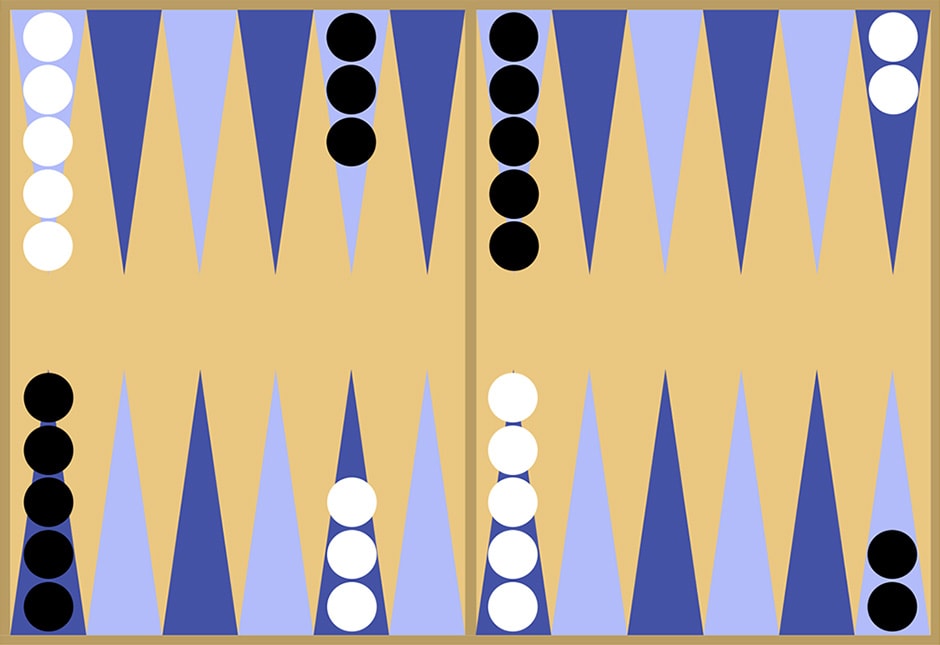
A standard backgammon layout with twenty-four points and two sets of fifteen counters.
Backgammon is one of the oldest known board games and one of the simplest to learn. Two players race their counters around the board, using dice to move, hit, and bear off their pieces. The rules are straightforward, but the mix of probability and strategy makes backgammon endlessly replayable.
The backgammon board has twenty-four long triangles, called points, divided into two halves (one for each player) and into inner and outer boards. Each player controls fifteen counters in a contrasting colour. From each player’s perspective, their home board is the inner quadrant on their right-hand side; the opposite inner quadrant is their opponent’s home board.
From White’s perspective, the points are numbered 1 to 24, starting at the rightmost point in White’s home board and moving clockwise. White’s counters are placed with two on the 24-point, five on the 13-point, three on the 8-point, and five on the 6-point. Black mirrors this arrangement on the opposite side of the board. To begin, each player rolls one die; the higher roll starts and plays both numbers as their first move.
On every turn, a player rolls two dice. Each die gives a separate move value that can be used either on different counters or combined for a single counter, provided each step is legal. A double (for example 5–5) gives four separate moves of that value instead of two.
From White’s perspective, counters move clockwise around the board towards White’s home board. From Black’s perspective, counters move anticlockwise towards Black’s home board. Hitting an exposed counter and controlling key blocking points is just as important as simply racing forwards.
Counters continue to circulate around the board until all fifteen of a player’s counters are safely inside their own home board.
Once a player has all fifteen counters in their home board, they may begin bearing off (removing counters from the board). Bearing off is done using the numbers rolled on the dice.
The first player to bear off all fifteen counters wins the game.
Backgammon is often played for points or money using a doubling cube. The cube shows the values 2, 4, 8, 16, 32 and 64, representing the current stake multiplier.
Many groups play backgammon with local variations that change the pace or risk profile of the game. Two of the best known are Dutch Backgammon and Acey Deucey.
Acey Deucey is a fast, swingy variant popular in the US military, with more dramatic swings in position and stake.
Online and club rules sometimes further tweak the doubling procedure, for example by removing gammon/backgammon multipliers, allowing automatic doubles on the opening roll, or offering an automatic "redouble" option when a double is accepted.
Get 15% off your order when you sign up.